A Chinese Medicine Guide to Wildfire Smoke
When wildfire smoke settles into the valley, the body often feels it before we consciously recognize what is happening. Your throat may feel dry, your chest may feel tight, your energy may drop, and your nervous system may feel more unsettled.
In Chinese Medicine, the Lung system supports far more than breathing. It influences the skin, the movement of Qi, our protective Wei Qi, and our ability to receive what nourishes us while releasing what we no longer need.
Wildfire smoke often presents as a combination of heat, dryness, and irritation. Support during smoke season is about protecting your energy, nourishing depleted fluids, gently circulating Qi, and giving your body the conditions it needs to recover.
Begin with cleaner air
These practices are most supportive when you are inside with cleaner air. Check the current AQI, reduce strenuous outdoor activity, and create a cooler, filtered indoor space whenever possible.
When your indoor air is clean, it is safe to allow your breath to deepen comfortably. Keep it relaxed and gradual rather than repeatedly pulling large breaths into irritated lungs.
Coughing, wheezing, or shortness of breath are signs to reduce your exposure immediately. Seek medical care for difficulty breathing, chest pain, heart symptoms, or symptoms that continue to worsen.
Protect your Wei Qi
Wei Qi is the protective energy that circulates near the surface of the body. In Chinese Medicine, it is supported by the Lungs, nourished by the Spleen, and rooted in the Kidneys.
Smoke season can ask more of all three systems. Protecting Wei Qi means working with your body’s reserves instead of repeatedly pushing beyond them.
Breathe with ease
Keep your breathing natural and quiet. Rest your voice when your throat feels irritated, and skip forceful breathwork until you are in clean air and your breathing feels comfortable.
The Lungs move Qi while the Kidneys help receive and anchor the breath. A soft, steady breath can support this relationship without placing more demand on an already irritated system.
Nourish Spleen Qi
Choose regular meals that are cooked, moist, light, and easy for your body to transform. Soups, broths, steamed vegetables, rice, cooked grains, and simple stews are especially supportive.
The Spleen transforms food and fluids into the Qi and nourishment the body uses. Supporting digestion also gives the Lung system a steadier source of energy.
Support Lung fluids
Sip water, broth, or gentle herbal tea throughout the day. Warm or room-temperature drinks may feel more soothing than very cold drinks when the throat and chest feel sensitive.
In Chinese Medicine, dryness can consume the fluids that keep the Lung system moist and comfortable. Replenishing those fluids may help ease the dry, scratchy feeling smoke can create.
Conserve Kidney Qi
Do a little less when the air is heavy. Rest before you reach exhaustion and give yourself more room for sleep.
The Kidneys hold our deeper reserves and help root the breath. Conserving your energy allows the body to direct more of its resources toward regulation and recovery.
Keep a steady rhythm
Keep meals, sleep, gentle movement, and rest as consistent as you can. Predictable rhythms help the body feel supported during an unpredictable season.
Regularity is especially nourishing for Spleen Qi. It can also help the nervous system soften instead of remaining in a constant state of vigilance.
Make space for grief
The Lung system is connected with grief in Five Element Chinese Medicine. Smoke season may also bring sadness, worry, helplessness, or grief for the land and the beings affected by fire.
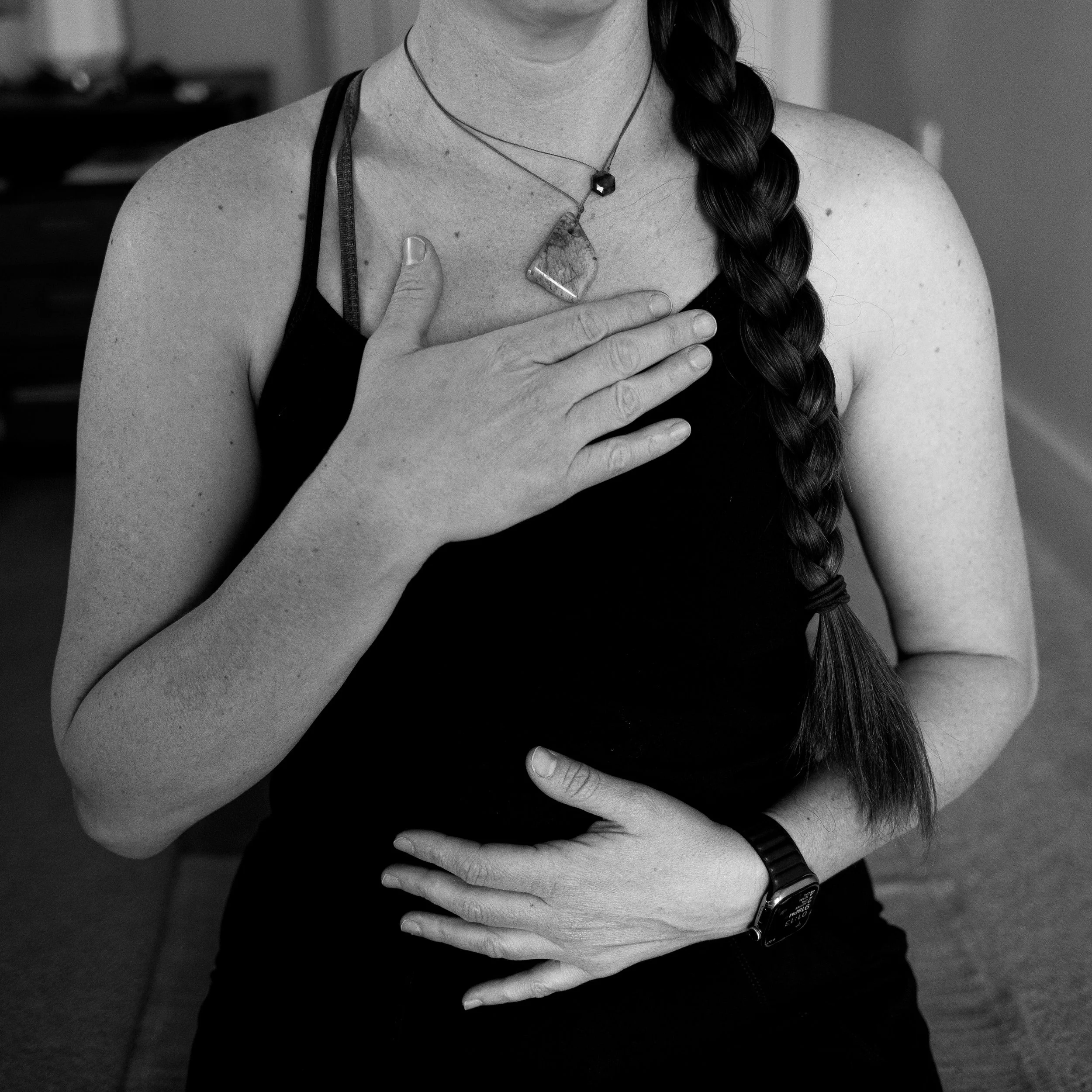
Place a hand over your chest and give yourself a moment to feel what is present. Let the exhale soften naturally, without trying to force an emotional release.
Nourish fluids and soothe dryness
Smoke can leave the throat, nose, skin, eyes, and lungs feeling dry and irritated. This is a time to bring more moisture into your meals while continuing to support healthy digestion.
Sip steadily
Take small, regular sips of warm or room-temperature water throughout the day. Broth and gentle tea can provide variety when plain water no longer feels appealing.
Steady hydration is often easier for the digestive system to receive than forcing large amounts all at once.
Favor moist cooking methods
Choose soups, broths, congee, stews, poached foods, and steamed vegetables. These cooking methods bring fluid directly into the meal and are generally easier to digest.
Moist foods support the Lung fluids while cooked foods help protect Spleen Qi.
Add cooked fruit
Try baked or poached pears and apples. A little honey can be added when it is appropriate for you.
Pears are traditionally used in Chinese food therapy to moisten the Lungs and soothe dryness. Cooking them makes them gentler on digestion, especially when the body already feels depleted.
Include gently moistening foods
Sesame, tahini, tofu, mushrooms, pears, apples, rice, and broth-based meals can help create a more moistening plate.
The goal is to nourish fluids without making digestion feel heavy or congested. Choose what feels comfortable for your individual body.
Keep meals simple and regular
Your body needs energy to create and distribute fluids. Eating regularly gives the Spleen a steady foundation for that work.
If your appetite is low, smaller cooked meals may feel more supportive than waiting until you are overly hungry.
Reduce what increases dryness
Ease up on alcohol, excess coffee, very spicy food, smoked or charred food, and an abundance of dry, crispy snacks.
You do not need to eat perfectly. Simply begin bringing a little more softness and moisture into what you are already eating.

Western herbs for dry, irritated days
These Western herbs were chosen for their traditional soothing, moistening, and gently supportive qualities. They are meant to support comfort and recovery while you continue reducing your exposure to smoke.
Begin with one herb or a simple blend. More herbs do not always create a better tea.
Marshmallow root
Prepare marshmallow root as a cold infusion, allowing it to steep in cool water for four to eight hours.
Marshmallow root releases a slippery mucilage into the water. This helps coat and soothe dry, irritated tissue in the mouth and throat and can be especially comforting for a dry, scratchy cough.
Because mucilaginous herbs may affect medication absorption, take marshmallow root separately from oral medications.
Mullein leaf
Prepare mullein leaf as a warm infusion and strain it very carefully through a coffee filter or tightly woven cloth.
Mullein has a long history in Western herbalism as a soothing respiratory herb. It is traditionally chosen when a cough feels dry, tight, or unproductive and the respiratory tissue needs gentle support.
The tiny hairs on the leaf can irritate the throat when they are not completely strained out.
Linden flower
Prepare linden as a warm infusion when dryness is accompanied by tension, restlessness, or difficulty settling.
Linden is gently moistening and relaxing. It can be a beautiful choice when smoke season is affecting both the throat and the nervous system.
Mallow flower
Mallow flower can be prepared as a gentle warm infusion for an irritated throat or dry cough.
Like marshmallow root, mallow contains soothing mucilage. It helps create a protective, moistening quality over dry tissues without feeling overly stimulating.
Chamomile flower
Chamomile offers gentle support for throat irritation while also helping the digestive and nervous systems soften.
It may be especially helpful when smoke season leaves you feeling tense, unsettled, or tight through the upper abdomen. Avoid chamomile if you have a known allergy to chamomile or related plants in the Asteraceae family.
Elderflower
Elderflower is a lighter, more aromatic herb traditionally used for early upper-respiratory discomfort.
It may be helpful when irritation is accompanied by mild stuffiness or the feeling that something is beginning. It is less moistening than marshmallow or mallow, so it may be paired with one of those herbs when dryness is the primary concern.
Talk with your practitioner, physician, or pharmacist before using herbs if you are pregnant, breastfeeding, taking medication, managing a medical condition, or prone to allergic reactions.
Acupressure to support your lungs
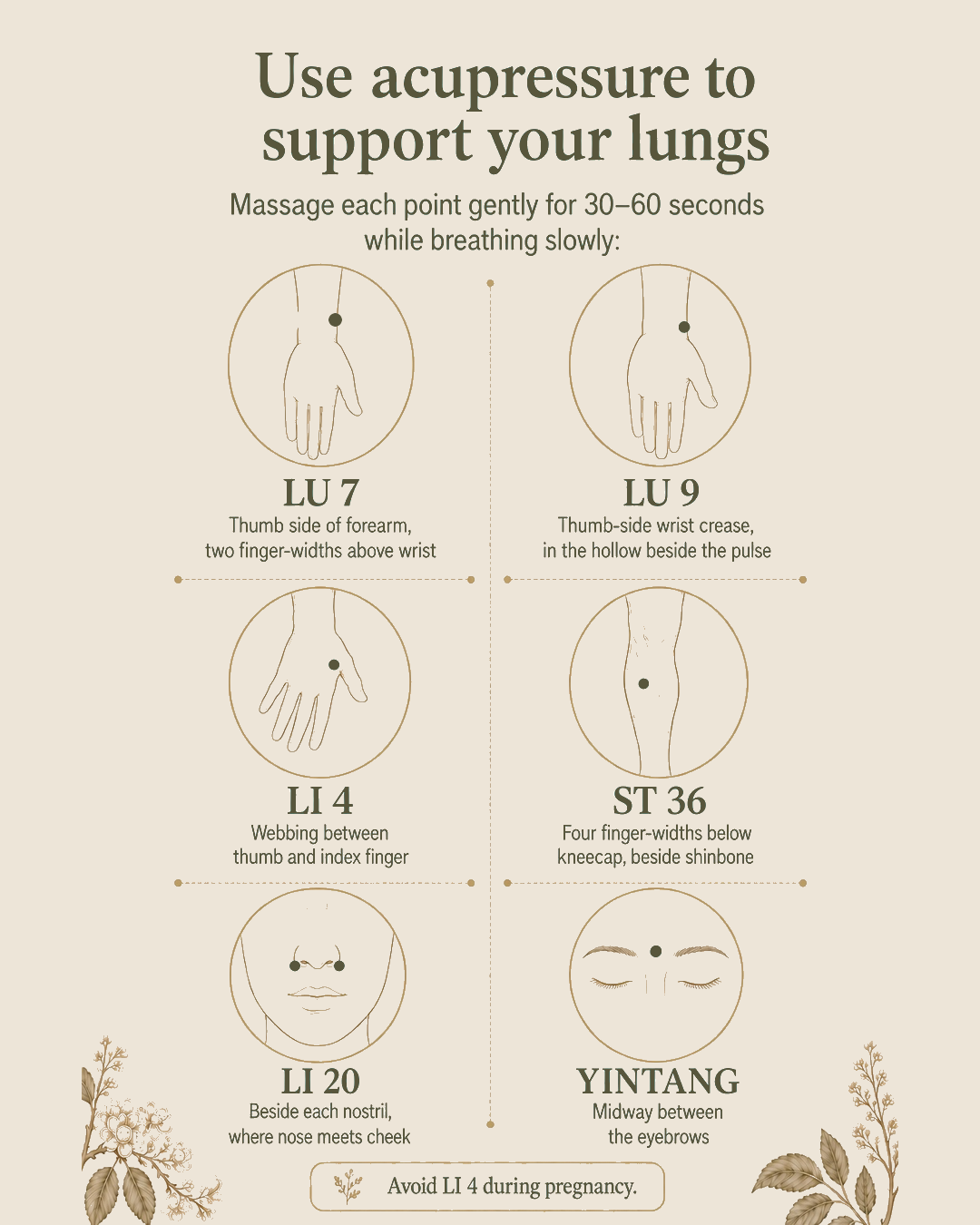
Massage each point gently for 30 to 60 seconds while allowing your breath to remain comfortable. You can choose one or two points that fit how you are feeling rather than using all six every time.
Pressure should feel clear and nurturing. Stop if you experience sharp pain, numbness, dizziness, or increased discomfort.
LU 7, Lieque
Location: On the thumb side of the forearm, approximately two finger-widths above the wrist crease, in the small groove above the bony prominence of the radius.
Why use it: LU 7 is traditionally used to regulate Lung Qi, support the throat and nose, and encourage Lung Qi to descend. It can be helpful when the upper chest, throat, or breath feels constrained.
LU 9, Taiyuan
Location: At the thumb-side wrist crease, in the hollow beside the radial pulse. Press gently beside the pulse rather than directly over it.
Why use it: LU 9 is the source point of the Lung channel. It is traditionally chosen to nourish Lung Qi and Lung Yin, making it especially appropriate when dryness is accompanied by fatigue, weakness, or a feeling of depletion.
LI 4, Hegu
Location: In the webbing between the thumb and index finger, near the highest point of the muscle when the two fingers are brought together.
Why use it: LI 4 moves Qi and is traditionally used to benefit the face, nose, head, and paired Lung and Large Intestine channels. It may be helpful when smoke irritation is accompanied by nasal congestion or head pressure.
Skip LI 4 during pregnancy unless it has been specifically recommended by a qualified practitioner.
ST 36, Zusanli
Location: Approximately four finger-widths below the kneecap and one finger-width to the outside of the shinbone.
Why use it: ST 36 strengthens Spleen and Stomach Qi, supports digestion, and nourishes the body’s overall resilience. It supports the Lungs indirectly by helping the body create a steadier supply of Qi and nourishment.
LI 20, Yingxiang
Location: Beside each nostril, where the outer edge of the nose meets the cheek.
Why use it: LI 20 is a local point traditionally used to open the nasal passages and move Qi through the nose and sinuses. Use very gentle pressure when the area already feels irritated.
Yintang
Location: Midway between the eyebrows.
Why use it: Yintang helps calm the Shen, settle tension through the face and forehead, and support a more open feeling through the nasal passages. It can be especially comforting when smoke season leaves you feeling restless or overstimulated.
Gently move Lung Qi
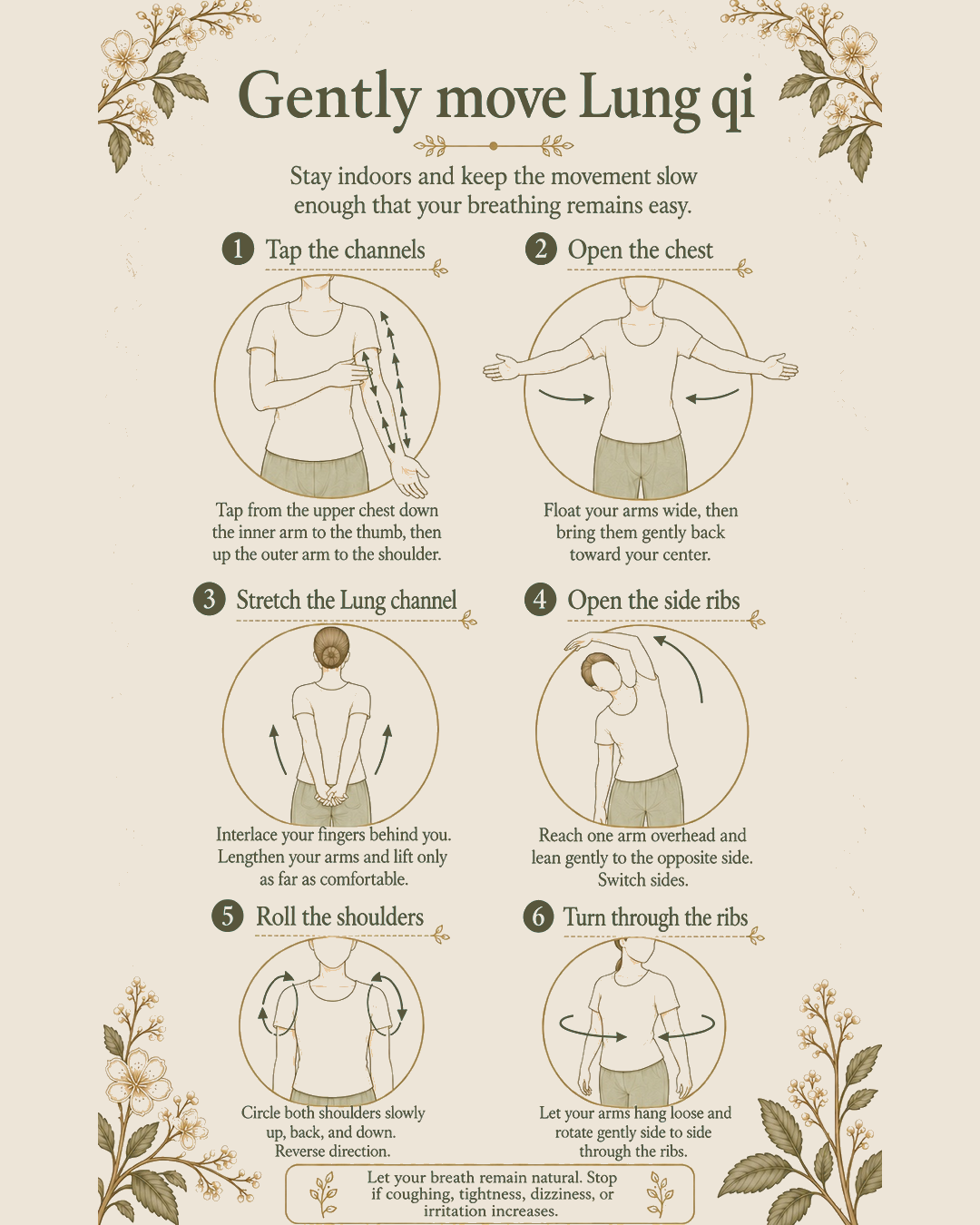
Movement can help the ribs, chest, circulation, lymph, and Qi stay mobile without asking too much from your breathing. Practice indoors with clean air and keep the movements slow enough that your breath remains easy.
Tap the channels
Begin at the upper chest and tap down the inside of one arm toward the thumb. Then begin at the index finger and tap up the outside of the arm toward the shoulder.
This follows the Lung and Large Intestine channels, which are paired in Chinese Medicine. Tapping brings awareness and circulation into the pathways associated with breath, release, and Wei Qi.
Open the chest
Float your arms outward with your palms open. Bring them gently back toward your center.
This creates movement across the chest without forcing a large inhalation. Let your ribs expand only as much as feels natural.
Stretch the Lung channel
Interlace your fingers behind your body. Lengthen your arms and lift them only as far as feels comfortable.
This opens the front of the shoulders, chest, and inner arms where the Lung channel travels.
Open the side ribs
Reach one arm overhead and lean gently toward the opposite side. Keep both feet grounded and repeat on the other side.
This creates space through the intercostal muscles and allows the lower ribs to move more freely with the breath.
Roll the shoulders
Circle both shoulders slowly up, back, and down. Reverse the direction after several rounds.
Shoulder tension can create a feeling of holding around the upper chest. Slow circles help soften that bracing without requiring strenuous movement.
Turn through the ribs
Let your arms hang loosely and rotate gently from side to side through your waist and ribs.
The movement should feel fluid and easy. It helps circulate Qi through the torso while allowing the arms and shoulders to remain relaxed.
Stop if coughing, tightness, dizziness, or irritation increases.

Why Chinese Medicine bodywork can help
Smoke season can affect the whole person. It may stir dryness, fatigue, muscular bracing, disrupted sleep, grief, and a deeper feeling of depletion.
Chinese Medicine bodywork allows us to work with the pattern your body is expressing that day.
Soften around the breath
When breathing feels irritated, the muscles around the chest, ribs, neck, diaphragm, and upper back may begin to brace.
Gentle bodywork can help these areas soften, creating more ease and mobility around your natural breath.
Support the Lung system
Acupressure and meridian work can be used to support the traditional functions of the Lung system, including the movement of Qi, the descending of the breath, and the relationship between the Lungs and Wei Qi.
Point selection is based on your individual pattern rather than using the same treatment for every person.
Nourish what feels depleted
Dryness may exist alongside fatigue, poor sleep, digestive weakness, or a feeling that your reserves are low.
Your session can include points chosen to nourish fluids, strengthen Qi, support digestion, and help your body gather its energy.
Support the whole pattern
The Lung, Spleen, and Kidney systems work together. The Spleen creates nourishment, the Lungs distribute Qi, and the Kidneys help root the breath and hold our deeper reserves.
Working with these relationships allows the session to support more than the place where you happen to feel discomfort.
Settle into deeper rest
Guided meditation, the vibroacoustic table, therapeutic sound, acupressure, and intentional touch create space for your body to soften into rest.
Sometimes the most supportive thing we can offer the body is permission to stop bracing and receive care.
Reconnect with yourself
As physical tension softens, there is often more room to notice what you have been carrying emotionally and energetically.
Your session is shaped around what your body is holding that day, helping you return to yourself with more space, presence, and ease.
If smoke season is weighing on your breath, energy, or nervous system, this is a beautiful time to receive support.